

If you go to any construction site, you’ll see the same thing: piles of sand on one side, bags of cement on the other, and workers mixing plaster by eye. It seems familiar. It’s what people do. But is it still the best way to build?
For builders today, manual processes are being rethought because of shorter deadlines, higher material costs, and higher standards for the quality of the finish. That’s where ready-mixed plaster is different.
Let’s settle the question for good: Ready mix plaster vs site mix plaster? Which really gives better results?
Key Insights
● When workers mix plaster by hand, they have to rely on their own judgment a lot, which makes it hard to keep things consistent on big or quickly-moving projects.
● The factory-controlled batching of ready-mixed plaster makes sure that the quality is always the same. This makes the walls stronger and the finish more reliable.
● Pre-mixed plaster is cheaper over the lifecycle of a project because it saves money on materials and can be used faster.
● Getting rid of the need to store sand and cement on-site makes the site safer, cleaner, and more productive.
● Due to tight deadlines, higher standards for finishes, and limited space, ready mix plaster is the more reliable and scalable option for modern construction.
What is Traditional Site-Mix Plaster?
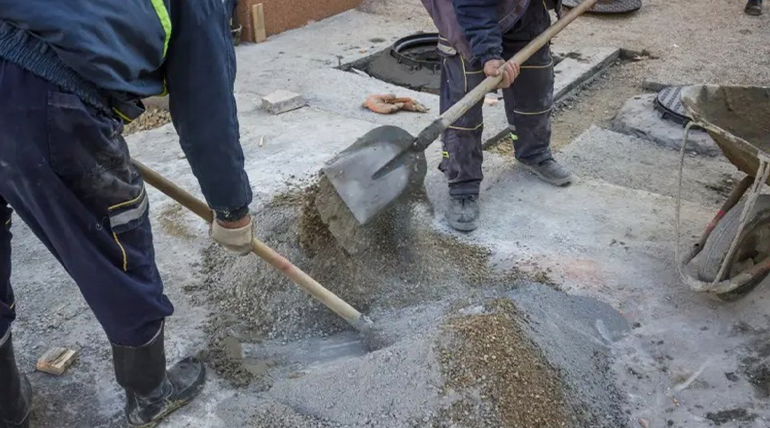
Site-mix plaster is prepared on location by manually combining cement, sand, and water. The quality of the mix depends entirely on labor skill, judgment, and consistency.
While this method has been used for decades, it comes with unavoidable limitations:
● Inconsistent ratios
● High material wastage
● Slower application
● Space constraints on-site
These challenges become more visible as project scale and expectations increase.
What is Ready Mix (Pre-Mixed) Plaster?
Controlled batching systems are used in factories to make pre-mixed plaster. The cement, aggregates, and additives are all carefully measured to make sure that the work always turns out the same.
Not only does it come ready to use, all you need to do is add water. It’s meant to make wall rendering better and construction more efficient overall.
Ready Mix Plaster vs Site Mix Plaster: Key Differences That Matter
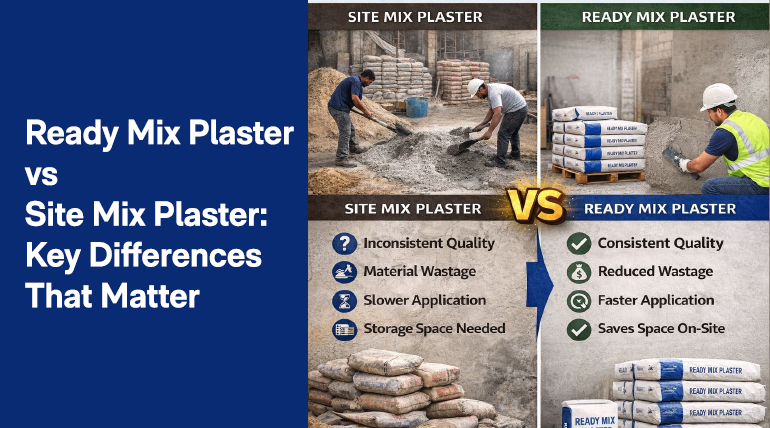
Here are the differences between ready-mix plaster and site-mix plaster:
1. Consistency: Machines Don’t Guess
Manual mixing depends heavily on judgment, and even minor ratio errors can impact wall performance. Over time, this inconsistency shows up as visible defects and uneven strength.
With site-mix plaster, small variations often result in:
● Uneven strength across walls
● Surface cracks after curing
● Patchy or uneven finishes
This uncertainty is taken away by ready-mixed plaster. Each batch is machine-calibrated to make sure that the texture, strength, and finish are all the same. This makes the product last longer and look better.
Winner: Ready mix plaster
2. Wastage: Less Loss, More Control
A big hidden cost on construction sites is the waste of materials. Every step, from preparation to use, where mixing is done by hand increases loss.
Common issues with site-mix plaster include:
● Over-mixing beyond requirement
● Spillage during handling
● Rejected or inconsistent batches
● Rebound loss during application
Pre-mixed plaster cuts down on waste by providing controlled, ready-to-use material. This helps keep costs down and makes work sites cleaner and more organized.
Winner: Ready mix plaster
3. Time: Faster Application, Faster Completion
Site-mixing not only takes time and effort, but it also delays projects. Handover dates are often pushed back because of delays in mixing, curing, and rework.
Ready-mix plaster helps by
● Speeding up on-site application
● Reducing rework caused by inconsistencies
● Enabling faster and more predictable curing
● Keeping projects aligned with schedules
For builders handling multiple units or tight delivery timelines, this time efficiency becomes a decisive advantage.
Winner: Ready mix plaster
4. Space: Build Walls, Not Storage Zones
Plastering the old-fashioned way requires a lot of storage space on-site, which quickly makes the work area look cluttered. This is a big problem for urban projects that don’t have a lot of room.
Site-mix plaster typically requires:
● Sand heaps
● Cement bag storage
● Dedicated mixing zones
Ready-mixed plaster gets rid of the need to store large amounts of materials. This frees up space on the job site, makes it safer, and makes it easier to move around and get things done.
Winner: Ready mix plaster
Cement Plaster Benefits That Go Beyond Convenience
Not only will using ready-mixed plaster save you time, but it will also make every wall look better.
● Better adhesion and a smoother finish make the wall rendering more even.
● Less shrinkage cracks because the composition is controlled and the additives are optimized.
● Consistent strength across surfaces, eliminating weak patches caused by manual mixing.
● Enhanced long-term wall durability, minimizing repairs and surface failures over time.
These cement plaster benefits lead to fewer site issues, lower maintenance costs, and greater satisfaction for both builders and homeowners.
Why Builders and Homeowners Are Making the Shift?
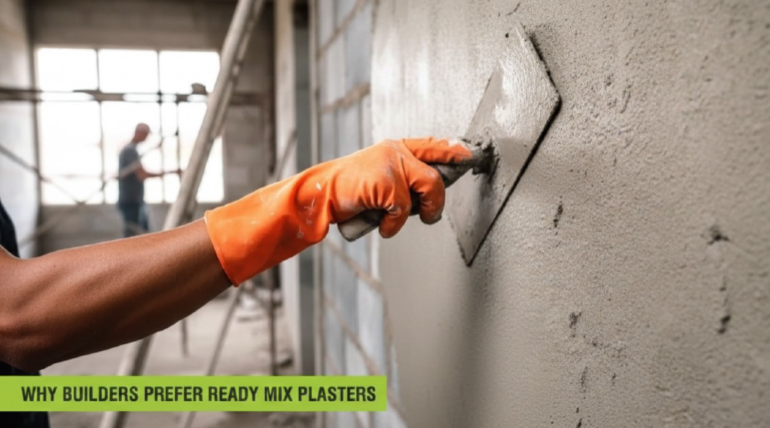
The industry is moving toward solutions that offer:
● Predictable outcomes
● Faster execution
● Lower lifecycle costs
When it comes to modern building needs, it’s clear which is better: ready-mixed plaster or site-mixed plaster. Pre-mixed plaster is better for today’s quality and efficiency standards, whether it’s for a small or large building project.
If you are in search of the best quality ready mix plaster, check out the range of products here.
Final Verdict: Which Wins?
People may be used to traditional site-mix plaster, but being used to something doesn’t always mean it works well or is reliable.
Ready-mixed plaster stands out because it gives consistent quality without any guesswork, wastes a lot less material, speeds up project timelines, and keeps work sites cleaner and safer.
If builders and homeowners want long-lasting products with better finishes and more efficient building, this is now the only option.